TranslationLab JS Crack the genetic code with cell-free translation experiments
1. RNA synthesis

Build the RNA Template

Select one to four nucleotide bottles. Empty bottles are ignored, and the remaining bottles become the repeating unit.

Nucleotide bottles
Four empty nucleotide reagent bottles and the RNA synthesis button.

RNA template

Repeat unit: none

Choose nucleotides, then click Make RNA.

2. Protein synthesis

Cell-Free Translation Mix

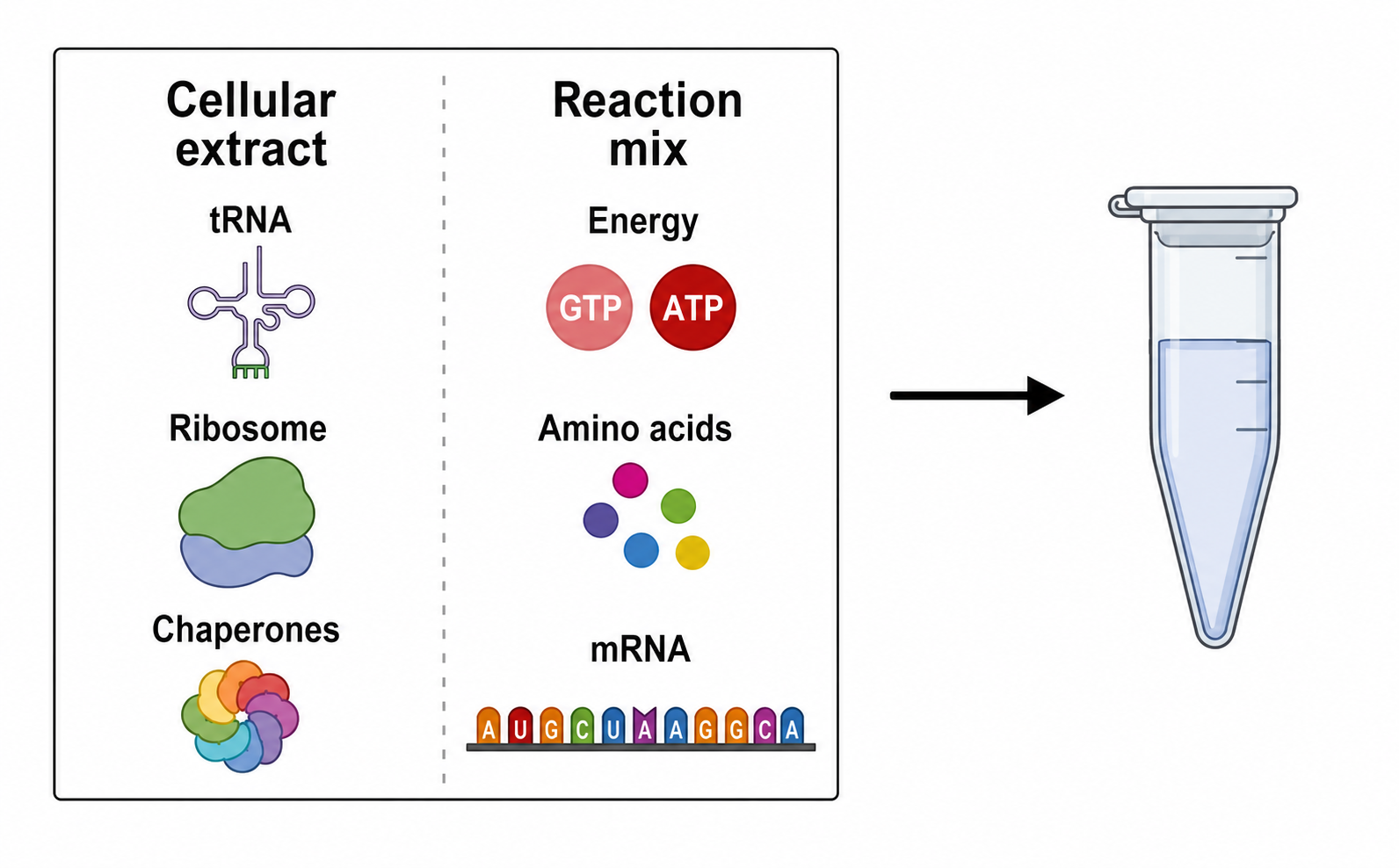
Add the RNA to a cell-free extract, incubate the tube in a water bath for 60 minutes, then move the reaction to analysis.

Ready for a synthesized RNA template.

3. Protein analysis

Sequencer Results

Run an experiment to compare detectable peptide products.

No protein sequence has been measured yet.

Assignments

These prompts preserve the inquiry path of the original TranslationLab activity: predict, run a small experiment, compare results, then revise the model.

Background

The Question

By the early 1960s, biologists knew that hereditary information was stored in nucleic acid sequences, but they still had to explain how a four-letter RNA alphabet could specify proteins built from twenty amino acids.

Marshall Nirenberg and Heinrich Matthaei used cell-free extracts from E. coli to show that artificial RNA could direct protein synthesis. Poly-U RNA produced poly-phenylalanine, making UUU one of the first cracked words in the genetic code.

The Method

Gobind Khorana's repeating RNA templates made it possible to compare polymers such as ACACAC..., AACAAC..., and CAAGCAAG.... Translation in crude extracts can begin at several positions, so a single repeating template may produce more than one peptide sequence.

Stop codons behave differently. A triplet repeat that contains a stop codon can still reveal other possible starts, while many tetranucleotide templates with stop codons terminate too early to produce a detectable protein.
Glossary

Help

Running an experiment

Select one to four nucleotides in the bottle controls. Empty bottles are ignored. The selected nucleotides form a short repeat unit that is polymerized into a longer RNA template.

Reading the output

The sequencer reports detectable peptide populations. Because the extract initiates randomly, the same RNA can be read from different starting positions.

Notebook and export

Use the Add note buttons to save RNA templates or peptide results. Use the note box for predictions and conclusions, then export the notebook as an HTML file.

Credits

Produced by:

  • Jeff Bellfaculty, CSU Chico
  • Bob Desharnaisfaculty, CSU LA
  • David Risnersoftware engineer, CSU LA
  • John Dalyweb developer, CSU CDL
  • Jan McDearmoncopy editor

© 2002-2012 California State University. Development was partially supported by a grant from the U.S. National Science Foundation.